

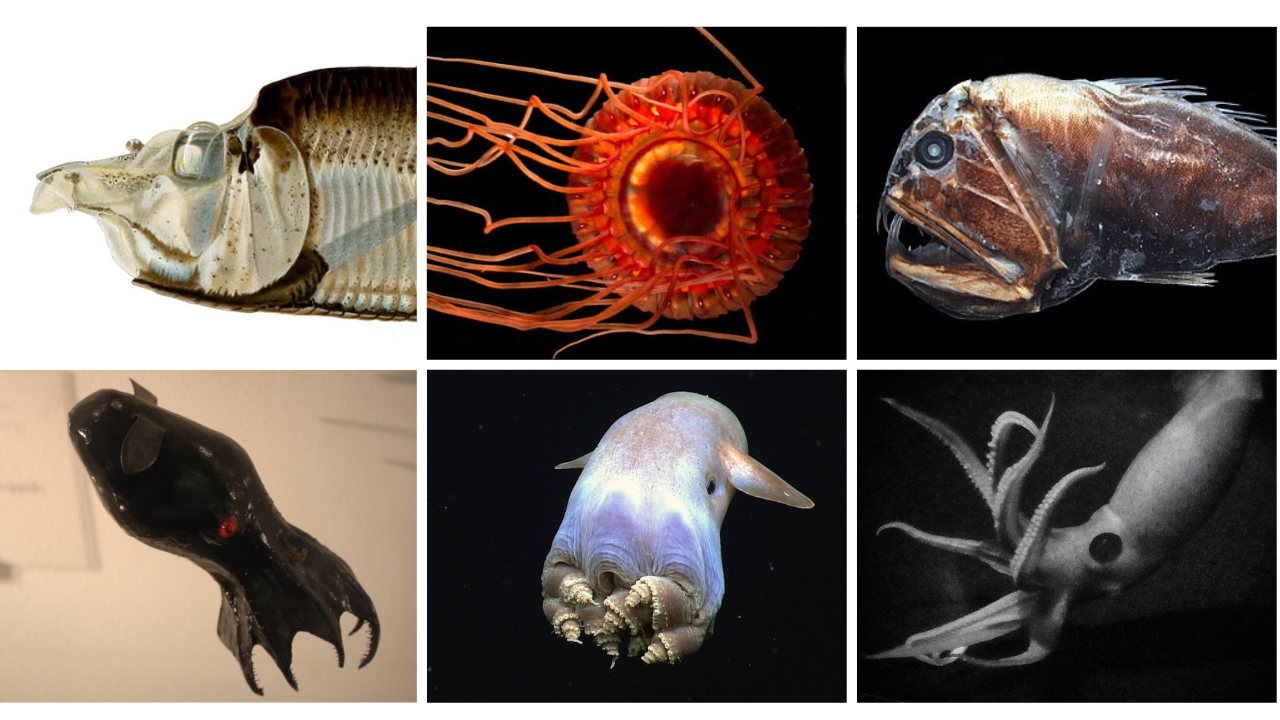
Far below the reach of ordinary sunlight, the ocean turns into a place where familiar rules seem to break. By about 200 meters, light fades fast, and below 1,000 meters the sea is functionally dark, forcing life to solve survival with stranger tools than most surface creatures ever need. That is why so many deep-sea animals appear unreal at first glance. Their see-through heads, dangling lights, ballooning mouths, and stilt-like fins are not accidents of nature, but hard-earned answers to darkness, pressure, thin food supplies, and the constant risk of disappearing unseen in a realm that still feels half-imagined.
Barreleye Fish
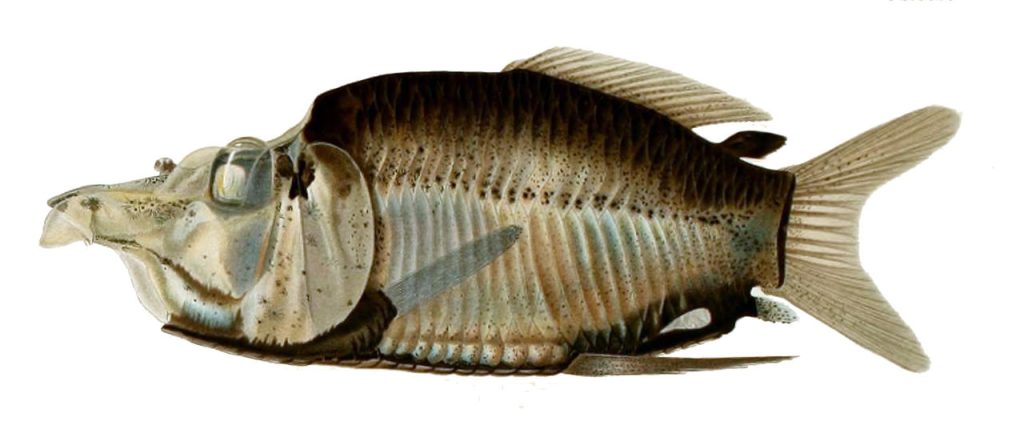
At first glance, the barreleye fish looks like a child’s sketch of a fish trapped inside a helmet. Its transparent, fluid-filled head reveals two bright green tubular eyes, while the spots that seem to be ordinary eyes are actually its nostril-like organs. Few deep-sea animals wear their oddness so openly.
MBARI researchers found that those light-sensitive eyes can rotate, letting the fish look upward for the faint silhouettes of prey and then forward while feeding. In water where light is scarce and meals are easy to miss, that strange glass dome protects a visual system built for precision in near darkness and careful strikes.
Vampire Squid
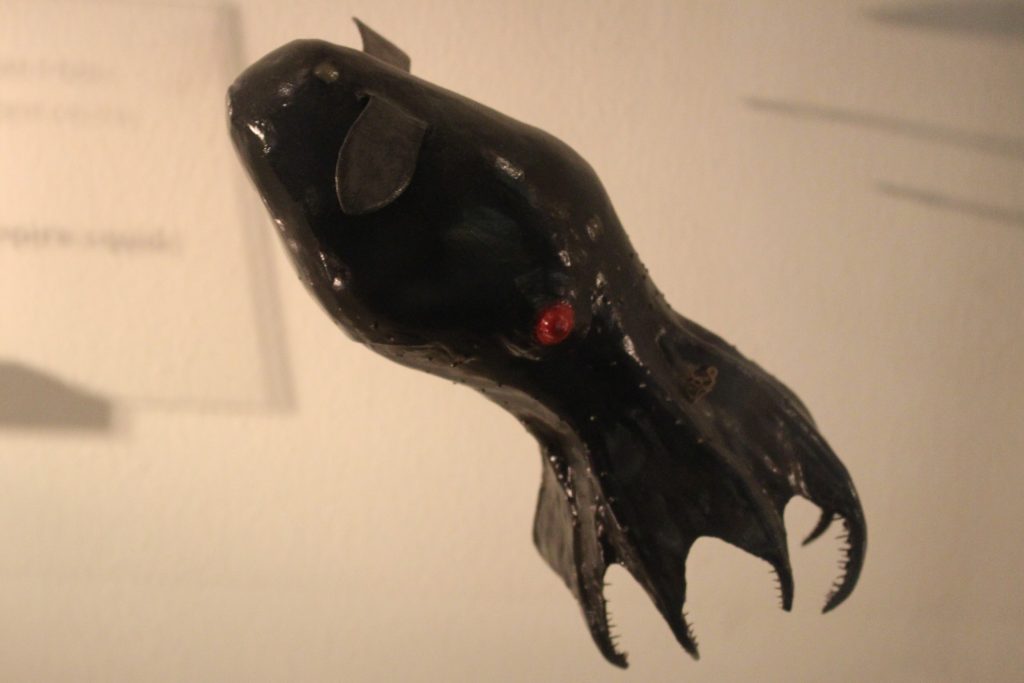
The vampire squid seems built by folklore: cloak-like webbing, luminous eyes, and thin filaments drifting from a dark red body. Yet it is less a hunter from nightmares than a careful survivor, floating through low-oxygen water where many faster animals struggle to last and food often arrives as scraps.
MBARI and NOAA describe those long filaments as tools for collecting marine snow, the sinking mix of dead plankton, mucus, and waste from waters above. Its body is tuned for buoyancy and energy efficiency, so it can hang almost motionless, gather drifting food, and spend very little in a place where every calorie counts.
Dumbo Octopus
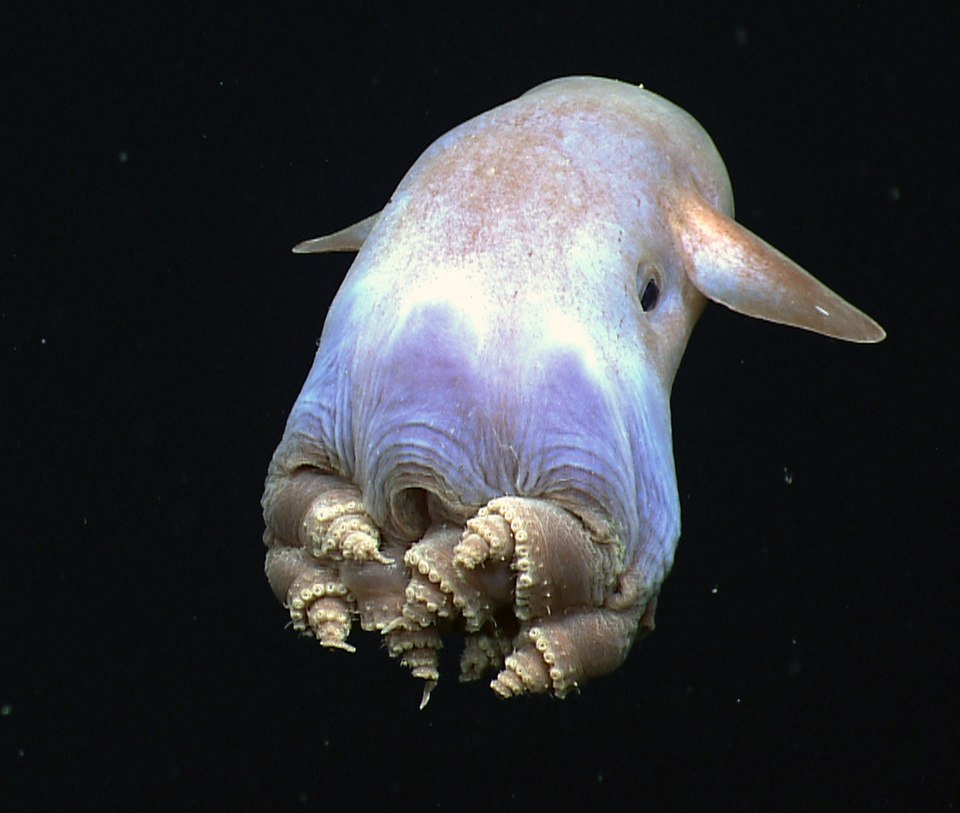
The dumbo octopus looks almost too charming for the deep sea, with soft webbed arms and ear-like fins that seem borrowed from a cartoon. That rounded shape is not decoration. It belongs to an animal living so deep and dark that some of the usual defenses of shallower octopuses are no longer worth carrying.
NOAA notes that dumbo octopuses lack an ink sac, which makes sense in permanent darkness, and use their large fins to move through the water. Instead of bursts of speed and clouds of ink, they rely on gentle fin strokes, drifting control, and a body plan suited to conserving energy at depths that can reach around 4,000 meters.
Deep-Sea Anglerfish
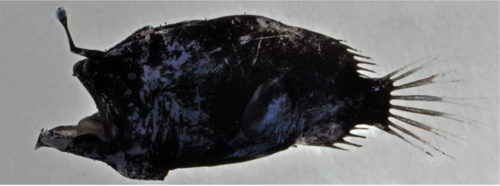
Few animals look more invented than a deep-sea anglerfish. Its blunt head, needle teeth, and glowing lure seem almost theatrical, as if the fish were trying too hard to look frightening. In truth, that hanging light is one of the smartest solutions in the ocean, because darkness turns attraction into ambush.
NOAA explains that females of some species host bioluminescent bacteria in the esca, the light organ at the end of the lure, to draw prey close. Food is not the only thing that is scarce. MBARI notes that in some species the tiny males attach to females, solving the problem of finding a mate in a vast, nearly empty sea.
Gulper Eel
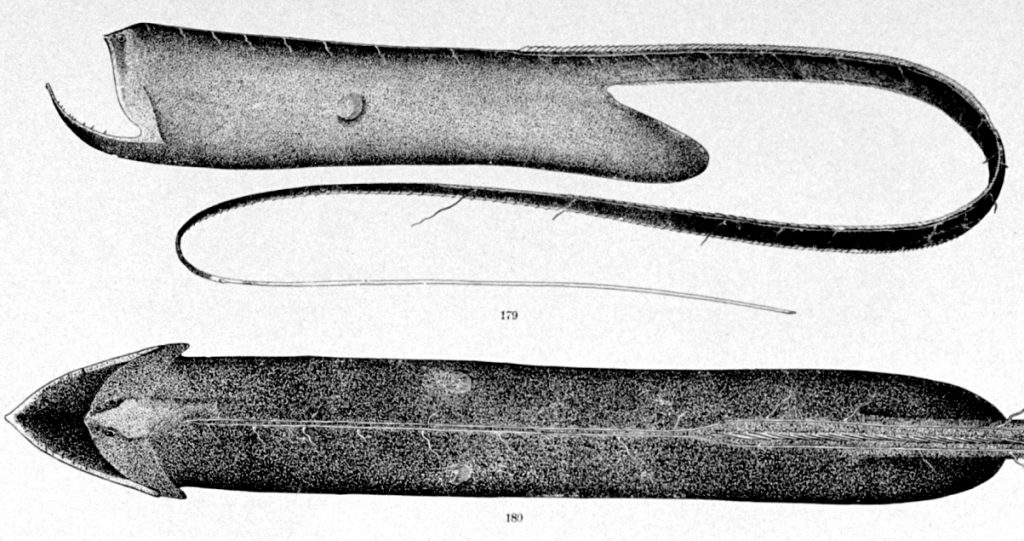
The gulper eel looks less like a fish than a loose sketch with an oversized mouth clipped onto a tail. Its jaws can open to a startling width, making the whole animal seem almost inflatable. That shape reflects a simple deep-sea truth: meals are unpredictable, and passing up a large one can carry real risk.
NOAA describes the gulper eel as a fragile fish with small, weak bones, a huge mouth, sharp teeth, and even a light at the tip of its whip-like tail. Instead of speed or brute strength, it leans on expansion and surprise. When prey appears, that giant mouth gives it a chance to swallow animals at least as large as itself.
Strawberry Squid
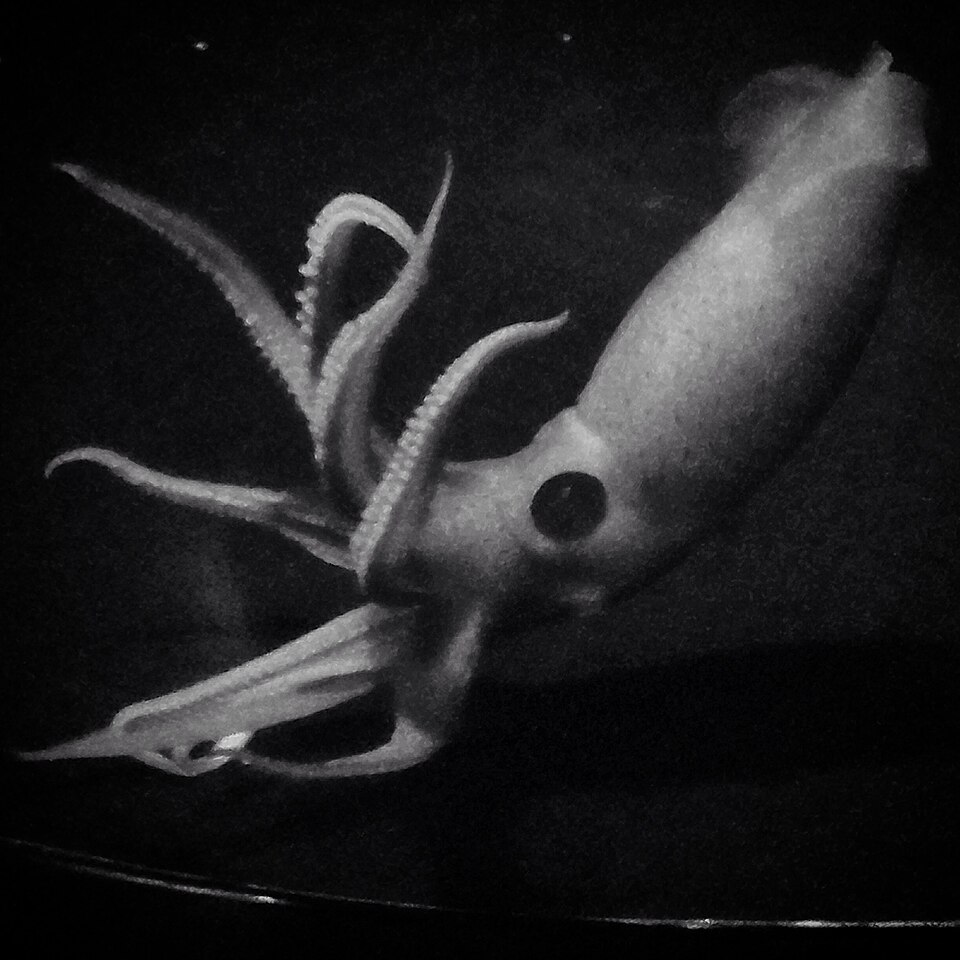
The strawberry squid looks mismatched in the most deliberate way possible. One eye is dramatically larger than the other, giving its face the uneven look of something from speculative art. In the dim twilight zone, those lopsided eyes divide the visual work with a precision that ordinary symmetry could not match.
MBARI explains that the large left eye points upward to catch faint shadows and collect downwelling light, while the smaller right eye looks downward for flashes of bioluminescence below. Its ruby body helps too. In deep water, red reads as black, turning a bright-looking squid into something hard for predators to notice.
Fangtooth Fish
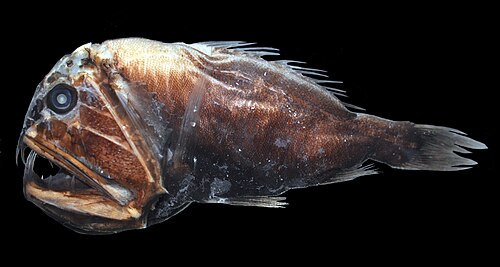
The fangtooth fish seems absurd on first look, as if its teeth were borrowed from a much larger predator and forced into the wrong mouth. Adults are actually small, but their fangs dominate the face so completely that the animal appears built around them. It is menace scaled down to a startling size.
Smithsonian Ocean notes that the fangtooth’s teeth are the largest in the ocean relative to body size. They are so long that the fish has special pouches in the roof of its mouth to keep them from piercing its brain when its jaws close. What looks grotesque is really careful engineering, allowing a compact predator to grip tough prey.
Tripod Fish
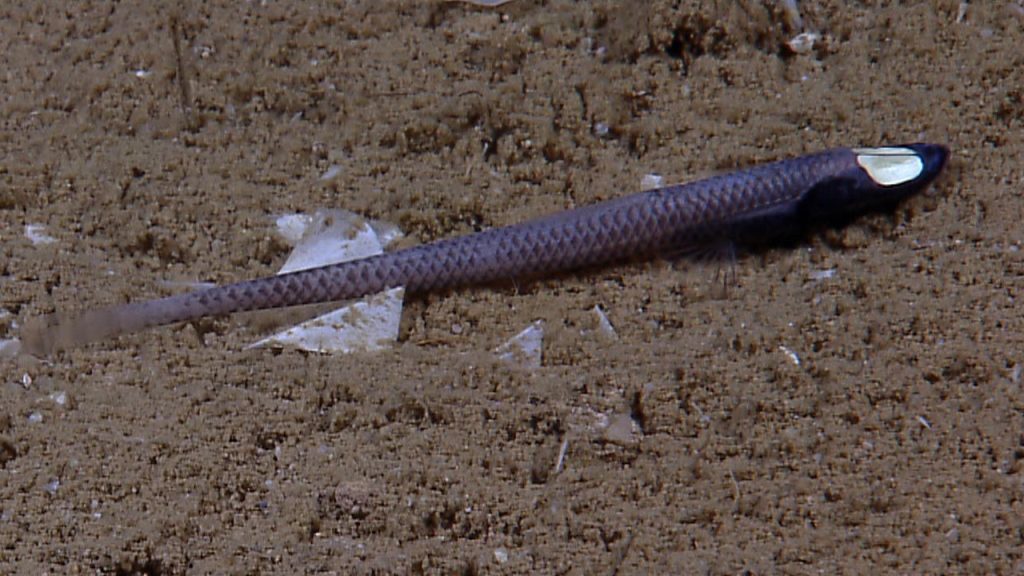
The tripod fish hardly looks alive at all when it settles on the seafloor. Balanced on elongated fins like a patient machine, it seems more like an instrument than a vertebrate. In the abyss, standing still can work better than chasing, especially when energy is precious and prey may arrive only by luck.
NOAA and Smithsonian describe this fish as an ambush predator that props itself on modified fins and uses sensitive feelers at the tips of its pectoral fins to detect nearby prey. Those long supports can be stiffened with fluid, turning fins into rigid stilts. The result is eerie to watch, but efficient for waiting in darkness.
Atolla Jellyfish
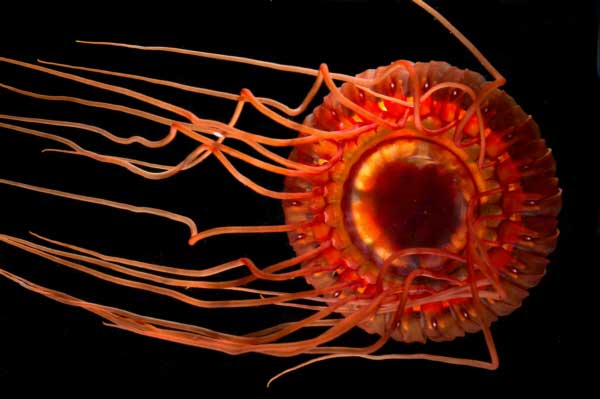
The Atolla jellyfish has the clean symmetry of a glowing ornament, but its beauty is a defense system. When threatened, it can send a spinning wave of light around its bell, creating one of the deep sea’s most dramatic displays. In darkness, spectacle can become survival if it shifts danger onto something larger.
NOAA describes this response as a bioluminescent burglar alarm. The flashing signal is thought to attract a bigger predator to attack whatever is attacking the jellyfish, giving it a chance to escape. That is why the animal can look more like a special effect than a jelly. Its body has turned light into a plea for rescue.