

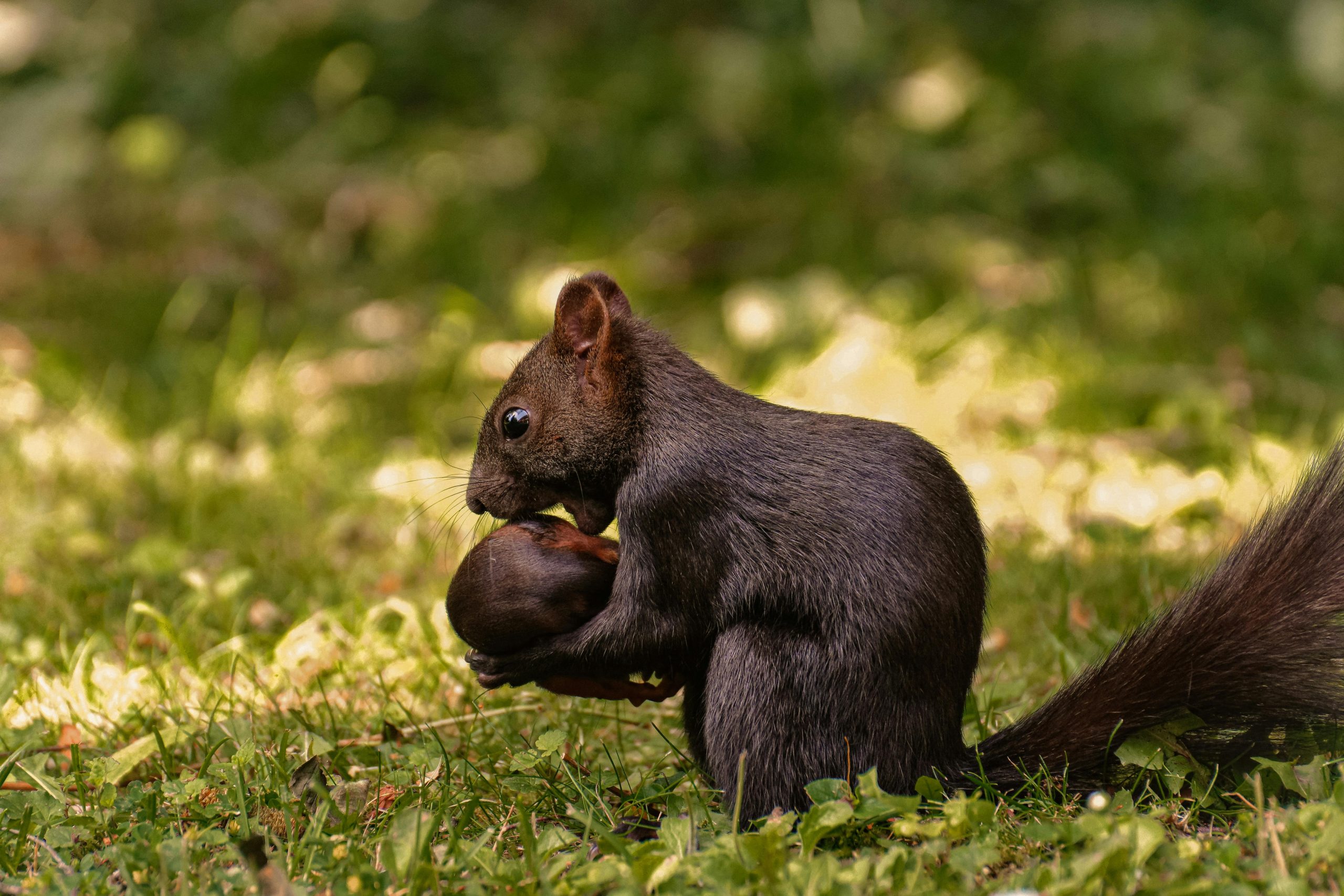

A black squirrel can look like a shadow that slipped off the tree line and learned to sprint. On a bright lawn or a pale winter sidewalk, that dark coat reads as unusual, even a little unreal, and people reach for spooky explanations. In most places, black squirrels are genuinely uncommon, which makes each sighting feel like a sign. But the story is less about omens and more about biology, climate, and cities. The same animal is simply wearing different pigment.
1. Black Fur Triggers a Predator Alarm

A solid black coat rewires the silhouette, so a passerby’s brain can file it under predator before it ever reaches squirrel, especially in peripheral vision or low light, where details vanish. In a quick trunk-to-lawn dash, that sleek shape can read like a rat, a mink, or a small cat hugging the bark, and the body tenses first, questions later, because humans overreact to dark movement and odd edges. In haze, porch shadow, or a windshield glance, the startle is psychology, not zoology, and it fades once the animal pauses, shows its tail, and calmly cracks a nut at noon, day after day, until it just looks like a squirrel in daylight too.
2. Rarity Makes It Feel Like a Message

Across much of the eastern gray squirrel’s range, the black morph is uncommon, so each sighting feels like the neighborhood backdrop has been edited and nature is hinting at something larger. Scarcity invites superstition and social proof, because rare animals get treated like clues that should be photographed, posted, and interpreted, then folded into local gossip and “Did anyone else see it?” threads. Yet around the Great Lakes, black squirrels can be frequent; some summaries describe the dark morph as under 1% overall but far higher in pockets, so the same coat can read as an omen in one town and as normal wildlife in another, in practice.
Source:
3. Melanism Sounds Like a Disease

The word melanism lands like a diagnosis, when it is simply a pigment pattern that produces darker eumelanin in the fur, like a natural dimmer switch turned up during hair growth. In eastern gray squirrels, genetic studies link black coats to a 24 base-pair deletion in the MC1R gene, where one copy often looks brown-black and two copies can be jet black, a big visual change from a tiny code tweak. It is inherited, not an illness or contamination, but the medical-sounding label makes ordinary biology feel alarming, even though melanism shows up across many wild animals and usually carries no penalty, and it can be passed along for generations.
Source:
4. People Assume It’s a Different Species

A black squirrel gets labeled as a new species because color is doing all the talking, and humans name what stands out before they study it, especially when it appears suddenly in a familiar yard. Biologists describe black squirrels as melanistic variants most often seen in eastern gray squirrels and fox squirrels, not a separate species with its own dietary, intelligence, or temperament, despite how different the coat looks in motion. When the coat is the headline, details like tail shape, ear size, and body build fade, and a familiar animal starts to feel like an intruder that slipped into the scene, unchanged, except for pigment, in truth.
5. Winter Contrast Makes It Look Unnatural

On snow, black fur looks like ink spilled on the landscape, and every hop reads sharper against a blank white ground that amplifies contrast and makes motion feel faster than it is. The same coat that blends into bark, wet leaves, and shadowed branches in summer becomes a high-visibility streak in January, like a moving punctuation mark crossing a driveway. That seasonal flip makes sightings feel staged or symbolic, even though the squirrel is simply running the same lanes between nests, food trees, and cached acorns, with weather changing the backdrop and human attention changing with it, especially when the landscape is quiet and white too.
6. City Light and Asphalt Favor Dark Coats

Cities create a darker world of asphalt, roofs, shaded parks, and night lighting that turns animals into bold shapes and silhouettes so color differences jump out from across a street. Research on eastern gray squirrels has documented urban–rural patterns in melanism, with higher frequencies of the dark morph in many city populations and lower frequencies in surrounding rural woods, a pattern repeated in multiple regions. Once that clicks, a campus full of black squirrels stops feeling eerie and starts reading like habitat, temperature, predation, and human-built geometry working together in plain sight, with roads as dark backdrops outdoors.
Source:
7. Cold Weather May Reward Dark Fur

Dark fur absorbs more solar radiation, and biologists have long asked whether that matters when temperatures plunge, wind cuts through branches, and mornings stay bitter for weeks. Experiments comparing gray and black morphs support the idea that melanistic squirrels lose heat more slowly in cold conditions, suggesting a thermoregulatory advantage when every calorie counts and food is harder to find. In northern climates, that can mean earlier active hours, longer foraging windows, and a better chance of getting through long winter spells without burning as much energy just to stay warm in the first place, when sun is low and nights are long.
Source:
8. Introductions Spread Surprise Populations

Not every black-squirrel hotspot is a mystery of evolution; some were moved by people who liked the novelty, stocked parks, or tried to rebuild local squirrel numbers after heavy hunting and habitat loss. Washington, D.C., is often cited as a place where black squirrels descend from animals brought from Ontario in the early 1900s and released near the National Mall, creating a lasting visual signature tied to a specific human choice. Once established, a conspicuous color morph can persist for decades, spread along green corridors, and become so normal locally that visitors assume it has always belonged there as if it were native to the parks.
Source:
9. Mixed Litters Confuse Expectations

People expect coat color to breed true, so mixed-color babies in one nest can feel suspicious, like nature broke its own rules and produced a surprise on purpose. In eastern gray squirrels, melanism is tied to the MC1R deletion allele described as incompletely dominant, meaning one copy can darken fur and two copies can intensify it toward jet black, with brown-black in between. That genetics lesson shows up as gray siblings beside brown-black juveniles, all born under the same tree, on the same seasonal schedule, to parents that look ordinary, which makes the “mystery” repeat every spring and the mix looks stranger than it is in one family.
Source:
10. Shiny Fur Looks Like a Different Texture

Black coats often appear glossier, especially after rain, which adds a slick sheen under streetlights and makes the animal look oddly polished, almost artificial, like a toy that learned to sprint. That texture shift is real to the eye even if the fur structure is not fundamentally different, because dark surfaces reflect highlights more sharply and hide subtle color variation that gray coats reveal in daylight. Combined with stop-and-go movement, sudden freezes on a fence rail, and bright reflections off wet fur, the look can feel uncanny even in a familiar backyard, until the light changes and the gloss softens, especially in photos, video.
11. Folklore Fills the Gaps

When an animal is uncommon stories rush in to explain it, and black squirrels collect legends, mascots, and campus myths that outpace facts and science classes, borrowing the mood of black cats and ravens. Some communities treat them as lucky or protected, while others link sightings to storms and odd coincidences that stick in memory because they are emotionally charged, shareable, and half-joking, passed around in group texts. The folklore persists because humans turn exceptions into meaning, and a simple genetic trait becomes a local symbol once it is noticed, repeated, argued over, and attached to place through tradition and school pride.
12. Photography Skews the Perception

Phone cameras crush shadows and saturate blacks, so the animal can look like a void with eyes instead of fur with depth and texture, especially in backlit scenes and winter light. At dusk, exposure algorithms brighten the background and deepen the coat, exaggerating contrast while motion blur erases brown highlights, whiskers, and tail details that would soften the look. What looks eerie on a screen is often a normal squirrel in daylight, but the camera’s quick decisions, plus filters and social sharing online, stretch the contrast until the uncommon coat feels like something else entirely, because the story in the caption shapes the feeling.