

For nearly 40 years, Uranus carried a reputation as the planet that broke the rulebook. Voyager 2 arrived in Jan. 1986 and found a contradiction no one could neatly resolve: a magnetosphere that looked strangely depleted, yet an electron radiation belt blazing with unexpected power. The data felt less like a pattern and more like a paradox.
Now that paradox has a sharper outline. New work published in Nov. 2025 argues that Voyager may have crossed Uranus during a rare space-weather burst, briefly supercharging conditions and turning one flyby into a misleading snapshot of a more dynamic world at exactly the wrong moment.
The Day Voyager 2 Broke the Model
Voyager 2 did not just pass Uranus; it rewrote the conversation around the planet in a few hours of measurements. Instruments recorded an electron belt so intense that later teams described it as rivaling the harshest radiation zones known outside Jupiter. At the same time, the surrounding plasma appeared unexpectedly sparse, leaving modelers with two observations that resisted a single explanation.
For decades, researchers treated those readings as the baseline state of Uranus. That decision shaped mission assumptions, risk estimates, and even ideas about how its moons and rings interact with charged particles across the system.
Why Uranus Was Not Supposed to Look Like This

Radiation belts usually reflect a balance between supply and loss: particles are injected, trapped by magnetic fields, then scattered or drained. Uranus seemed to violate that balance. Voyager saw a weaker ion belt than expected, but an electron belt near the upper edge of what the system should sustain, despite limited signs of fresh plasma feeding it.
That mismatch haunted planetary physics from the start because Uranus is already unusual. Its rotation is tipped close to sideways, and its magnetic field is offset and tilted, creating seasonal geometry unlike Earth, Saturn, or Jupiter and complicating every simple analogy.
The Space-Weather Suspect: A Co-Rotating Interaction Region
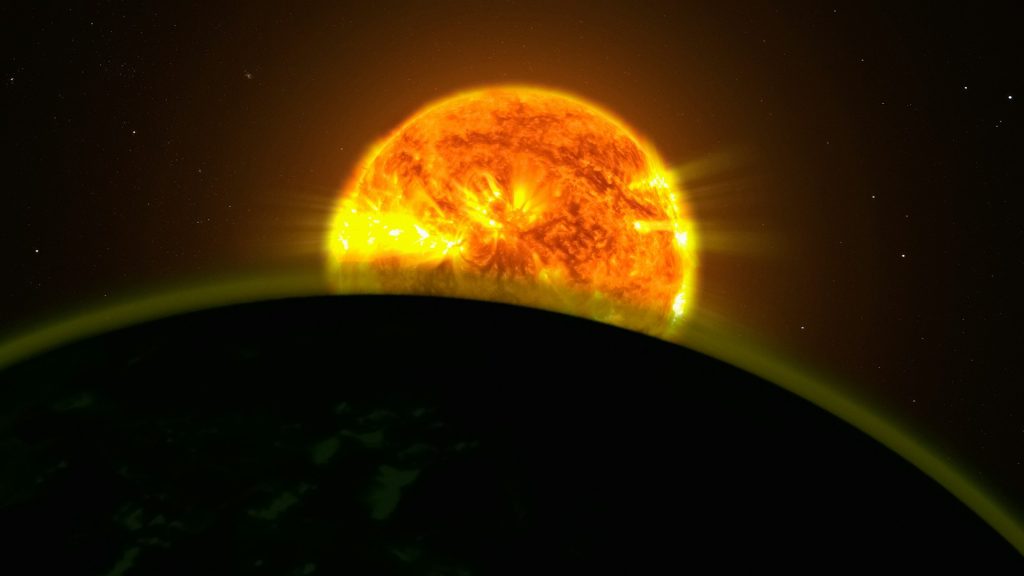
The leading suspect is now a co-rotating interaction region, a large solar-wind structure formed when faster streams catch slower ones. If one of these regions swept across Uranus during the flyby window, it could have compressed the magnetosphere, disturbed particle transport, and pumped extra energy into electrons that were already trapped.
This matters because the event is not a minor tweak. The new interpretation frames Voyager 2’s famous reading as storm-time behavior, not everyday behavior. In plain terms, Uranus may not be permanently overcharged; it may have been caught during a brief but powerful magnetic weather swing.
Earth’s 2019 Event Became the Missing Comparison

The turning point came from comparison, not speculation. Researchers matched Voyager-era signatures against a well-studied Earth episode in 2019, when a similar interaction region drove strong electron acceleration in near-Earth radiation belts. Patterns once treated as strange at Uranus began to look familiar when placed beside modern terrestrial data.
That cross-planet approach changed confidence in the hypothesis. Instead of asking why Uranus alone behaved so dramatically, scientists could ask how common storm physics might scale in a tilted, distant magnetosphere where solar wind forcing and geometry combine in unusual ways.
Chorus Waves: From Suspected Loss to Possible Accelerator
One subtle shift in interpretation may be the most important. Earlier thinking assumed intense wave activity would mainly scatter electrons downward, bleeding belt energy away into the atmosphere. The updated view allows the opposite outcome: lower-band chorus waves can energize a seed population and push electrons to relativistic energies.
That mechanism helps reconcile the old contradiction. A depleted-looking environment and a powerful electron belt are no longer mutually exclusive if a transient storm reshaped transport, then amplified electrons fast enough for Voyager to sample the peak before the system relaxed.
A Snapshot Misread as a Climate
A companion finding from recent Uranus work deepens the point: Voyager may have arrived during solar-wind conditions that occur only a small fraction of the time. One analysis estimated roughly 4% likelihood for that state. If true, then one of planetary science’s most cited Uranus snapshots was taken during unusual weather, not a calm average day.
The broader lesson reaches beyond Uranus. Single flybys are invaluable, but they can also freeze chance conditions into doctrine for decades. Revisiting legacy data with Earth-based context is proving that old measurements still contain new physics when interpretation frameworks improve.