


Dinosaurs dominate the imagination, but Earth’s deep history is crowded with other rulers, from armored fish and giant insects to saber-toothed hunters and whales shaped for warm ancient seas. These animals rose when continents looked unfamiliar and climates swung from steamy forests to harsh, windy plains. Some ruled by size, others by speed, armor, or specialized jaws that rewrote the food chain. Fossils capture them in fragments, yet the patterns are clear: long before modern wildlife, many worlds came and went, each with its own champions.
Anomalocaris, Cambrian Seas

Long before vertebrates dominated, Anomalocaris cruised Cambrian oceans as one of the era’s most formidable hunters. With stalked eyes, spined grasping limbs, and a round mouth built for gripping prey, it patrolled reefs and soft seafloors when complex life was still new. Smithsonian notes some species approached almost three feet, about one meter, making it a giant among its neighbors, and its camera-shutter mouth plus hook-like arms could pin slippery meals, then pass them inward as it glided above trilobite beds and sponge gardens in seas without fish, where every shadow was an invertebrate and speed mattered more than brute force in full.
Trilobites, Paleozoic Seafloor Swarmers

Trilobites were not a single monster but a long-running dynasty that filled Paleozoic seas for hundreds of millions of years. They crawled, burrowed, filtered, and sometimes hunted, protected by calcite armor and compound eyes that fossilized readily, and many could roll up for defense when predators cruised overhead. Britannica notes trilobites first appeared about 521 million years ago and persisted into the Permian, thriving through shifting continents and oxygen swings by evolving new shapes, spines, and lifestyles, from reef creepers to open-water swimmers that tracked food across muddy plains and shadowed shelves across seas, worldwide.
Dunkleosteus, Devonian Armored Hunter

Dunkleosteus ruled Late Devonian waters with a head like a fortress and jaws that worked like shears. Instead of teeth, it carried self-sharpening bony plates that snapped shut with startling speed, ideal for overpowering prey in open seas. As an armored placoderm in the so-called Age of Fishes, it stands among the earliest vertebrate apex predators, and recent estimates put many adults around three to four meters long, with rare giants bigger, their remains found across ancient seaways, a design that let it pivot, strike, and shear flesh in midwater while smaller hunters scattered, even if exact bite-force numbers remain debated in deep sea.
Arthropleura, Carboniferous Forest Giant

In Carboniferous wetlands, Arthropleura became the largest known land arthropod, a millipede relative that could stretch beyond two meters, and broader than a man. Trackways and body fossils show a heavy, many-legged traveler sliding through coal-age forests, often near waterlogged margins, where high oxygen and lush plant growth helped fuel gigantism. Reuters reports new head fossils hint at a slow detritivore with scores of legs, likened to an elephant in ecological role, reshaping the forest floor as it fed on decaying plants, and its disappearance later tracks shifting climates and shrinking swamp forests that ended the age of giant bugs.
Meganeura, The Giant Dragonfly Relative

Meganeura looked like a dragonfly from another planet, with a wingspan that could exceed 70 centimeters in the late Carboniferous. It patrolled swampy airspace above coal forests, where dense vegetation and oxygen-rich air supported insects on a scale unfamiliar today. Britannica points to Meganeura monyi as a gigantic dragonfly relative, and its likely hunting style was pure aerial control, snatching smaller insects in midair and turning open sky into a feeding ground before birds existed and long before bats, when wetlands hummed with wingbeats, warm mist, and the constant pressure of being prey or predator with no safe refuges in open air.
Dimetrodon, Permian Sail-Backed Predator

Dimetrodon is often mistaken for a dinosaur, but Britannica notes it lived in the Permian, roughly 286 to 270 million years ago. It hunted along river systems in what is now North America, using a deep skull and differentiated teeth to seize and slice prey when reptiles and mammal relatives were still sorting out their futures. The tall back sail, formed by elongated spines, likely helped with body temperature control or display in harsh dry seasons and it gave this synapsid an unmistakable silhouette, so a reminder that top predators existed long before dinosaurs and had already begun experimenting with the biology that later shaped mammals.
Inostrancevia, Saber-Toothed Survivor of the Permian

Near the end of the Permian, Inostrancevia emerged as a massive gorgonopsian with a long skull and saber-like canines. The Field Museum describes it as a top predator that moved into new territory as ecosystems destabilized before the Great Dying, intimidating smaller hunters and taking large dicynodont prey. Built with a powerful neck, a wide gape, and blade-like teeth for slashing, it filled a role that later cats would echo, yet it did so in a world of dry riverbeds, dust, and volcanic stress, where dominance could vanish overnight, and the coming extinction swept away most complex life on land leaving fossils that read like warning signs.
Megalodon, Shark Built for Big Prey

Megalodon carried the reputation of a superpredator for good reason, with serrated teeth designed to slice through thick flesh and bone. Smithsonian notes the largest individuals were roughly 60 feet long, and estimates often place females larger on average than males, a pattern seen in many living sharks. As marine mammals diversified, this giant likely targeted big prey along productive coasts, and its presence shaped entire ecosystems, yet almost nothing fossilizes except teeth, so the animal’s true body remains a silhouette built from comparisons, hinting at an ocean where even whales had reason to keep moving without lingering nearshore.
Smilodon, Ice Age Saber-Toothed Cat

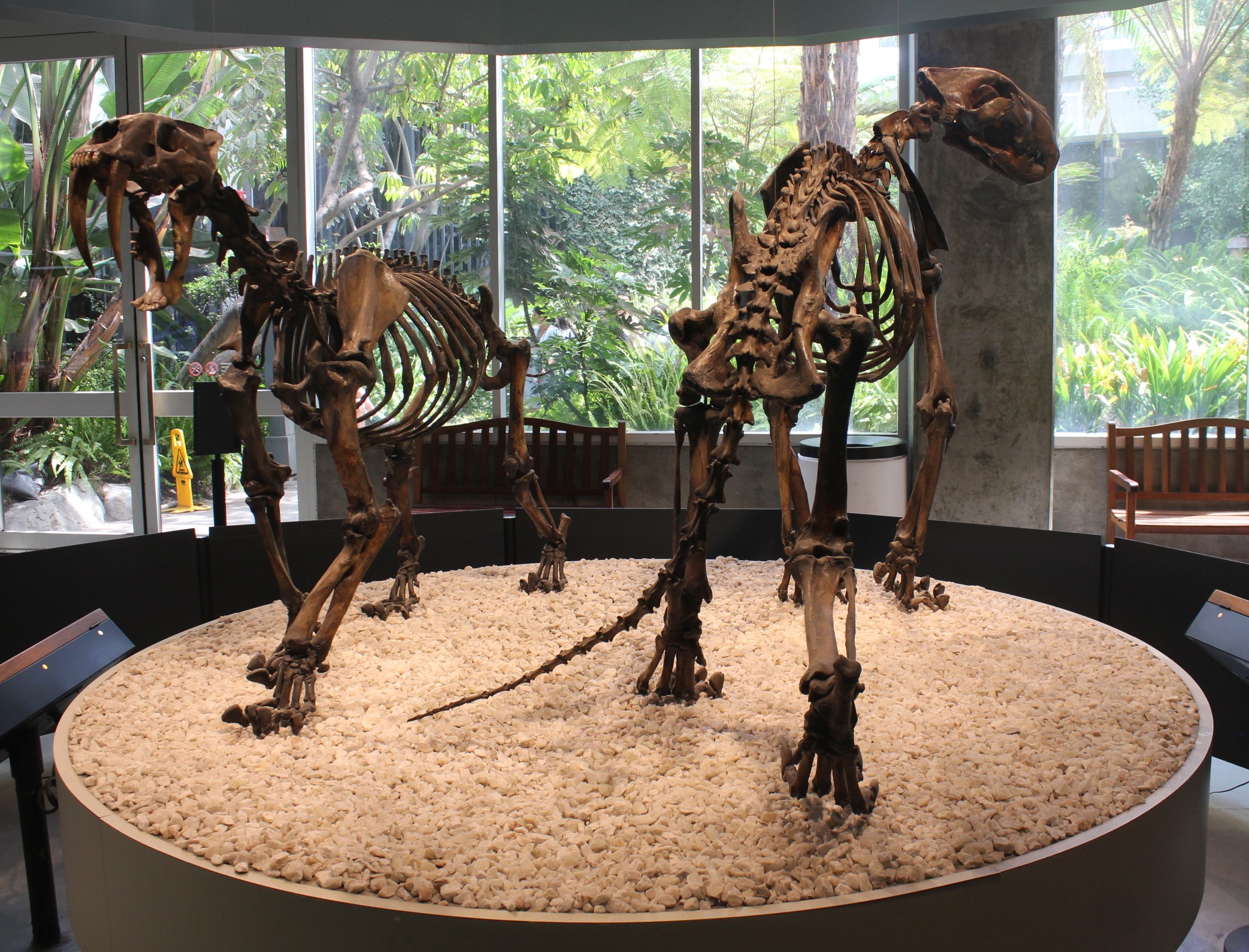
Smilodon became an Ice Age icon in the Americas, built low and powerful with upper canines that Britannica notes could reach about 20 centimeters. Rather than endurance running, it likely relied on ambush strength, pinning prey with muscular forelimbs before delivering a precise bite, an efficient strategy in patchy grasslands and woodland edges. Fossil sites like La Brea preserve its story in dense detail, showing a predator about the size of a modern African lion that thrived in the Pleistocene until shifting climate, shrinking prey, and human pressures tightened the margins for big cats in asphalt seeps that trapped entire food webs.