

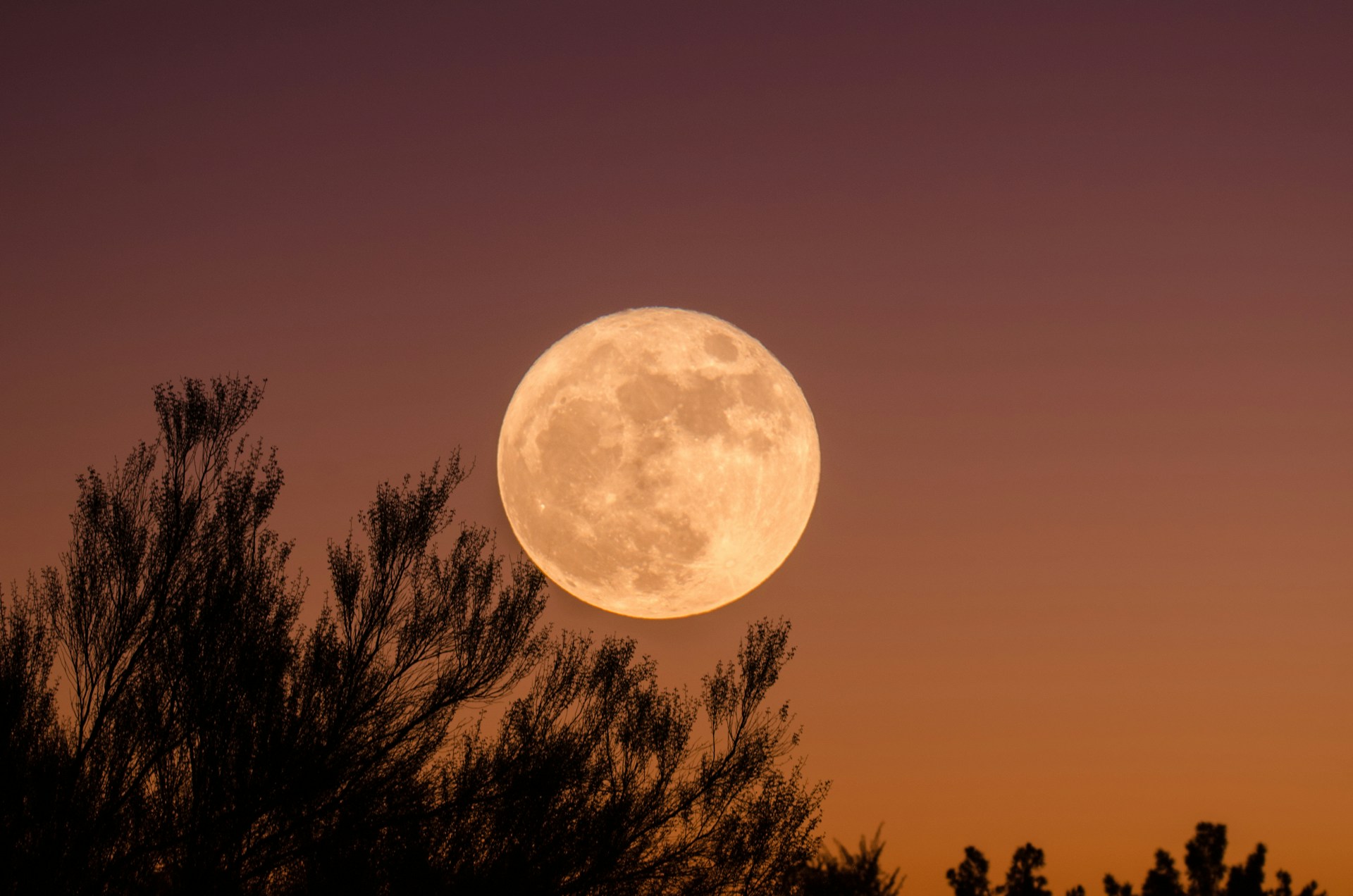
A rising full Moon can look strangely oversized, like it is pressing up against rooftops, trees, and hills with more weight than it should have. That feeling is powerful enough that people still pause and stare, even when they know better.
The hidden part is that the sky is not pulling off a visual trick with lenses or magnification. NASA explains that this is a real perceptual illusion, and scientists still do not have one single explanation that settles the question completely.
What The Moon Illusion Really Is
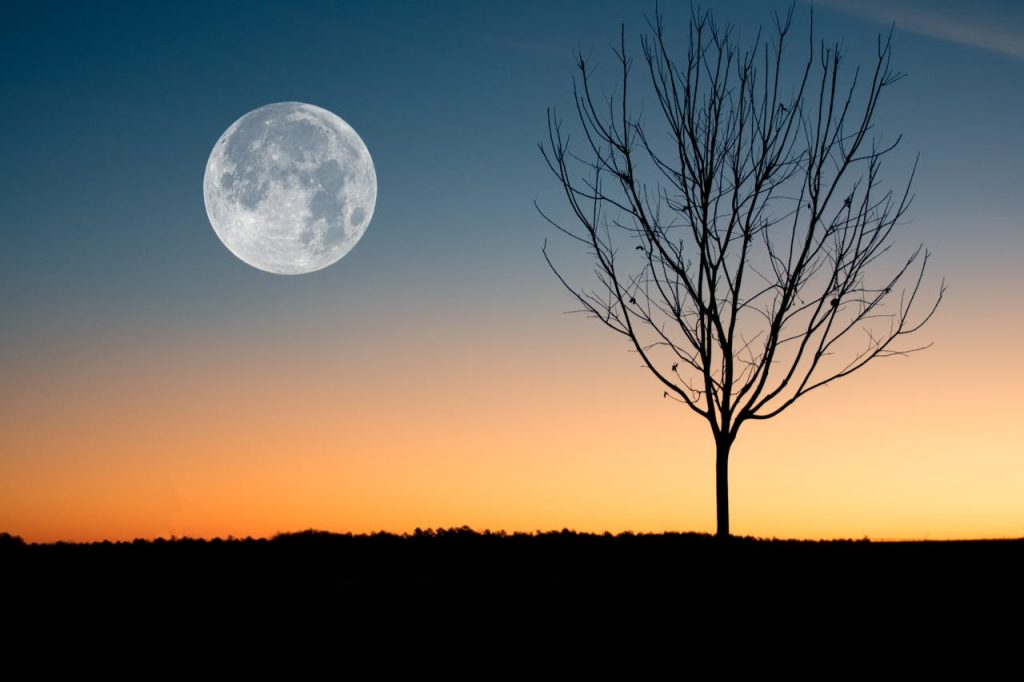
The Moon illusion is the mismatch between what the eyes receive and what the brain decides the Moon should look like.
NASA notes that photos taken with the same zoom show the Moon staying the same width near the horizon and high in the sky. The dramatic size change is in perception, not in the Moon itself.
That is why the effect can feel so convincing even when a camera proves otherwise.
People have been describing this illusion since ancient times, and NASA’s 2025 explanation points out that scientists are still testing ideas about it. The mystery is old, but it is not fully solved.
What It Is Not
The atmosphere is not magnifying the Moon when it sits near the horizon. NASA is very direct on this point.
In fact, NASA says atmospheric refraction can squash the Moon a little, especially vertically, rather than make it look larger. That is why a low Moon can look slightly flattened in photos.
The Moon is also not closer when it is on the horizon.
NASA’s 2025 explanation says the Moon is about 1.5 percent farther away at the horizon, which makes the apparent bigness even more clearly a brain effect. The physical geometry goes the opposite direction of what most people assume.
This is not a Moon-only event either. NASA notes that constellations can look unusually large near the horizon for the same general reason.
That detail matters because it shows the illusion is tied to how the brain reads the sky, not to something special happening only to the Moon. It is a broader perception issue.
It is also not proof that every giant-looking Moon is a supermoon.
A horizon full Moon can feel enormous on an ordinary night, and a true supermoon can still look subtle if it is high overhead and there are fewer visual cues around it. NASA’s supermoon page even notes that size differences can be hard to detect by eye.
Why The Brain Gets Tricked Near The Horizon
NASA says the leading ideas center on how the brain judges size and distance together. The brain is constantly estimating how far things are, then adjusting how large they seem.
Near the horizon, the Moon appears in a part of the sky filled with familiar scale cues like buildings, trees, and ridgelines. Those cues push the brain into making size judgments it would not make in empty sky.
NASA also points to expectations about distance at the horizon. The brain tends to treat horizon space as farther away than the open sky overhead.
If the brain treats the horizon Moon as farther away but its visual size on the eye stays about the same, the brain can interpret it as larger. That is one reason the illusion feels so real instead of looking like a gimmick.
NASA specifically mentions the Ponzo illusion as one way to think about it. In that classic setup, equal lines seem different in size because the scene suggests depth, like rails narrowing into the distance.
But NASA also stresses that this is not a complete answer. The Moon illusion still appears for astronauts in orbit, where normal foreground cues are missing.
That is why the most honest explanation is also the most interesting one: the illusion is real, several good theories exist, and the final story is still being worked out.
Foreground Objects Make The Effect Feel Stronger
A Moon rising behind a skyline almost always looks more dramatic than a Moon high above a dark field. The foreground gives the brain something to compare against.
NASA notes that trees, mountains, and buildings may help trick the brain into a stronger sense of scale and distance. The Moon can seem bigger and more present simply because it appears anchored to a landscape.
This is also why moonrise photos can be misleading if they are used as evidence that the Moon really changed size. A camera can make the effect look huge in a different way than the eye does.
NASA explains that photographers often use long lenses to compress distance and make the Moon and foreground appear larger together. That produces the famous giant-Moon-over-city look, but it is a zoom effect, not a sudden lunar growth spurt.
Even NASA’s supermoon page uses a forced-perspective image to show how size relationships in a frame can distort intuition. The eye loves a good scale trick.
How To Prove The Illusion To Yourself
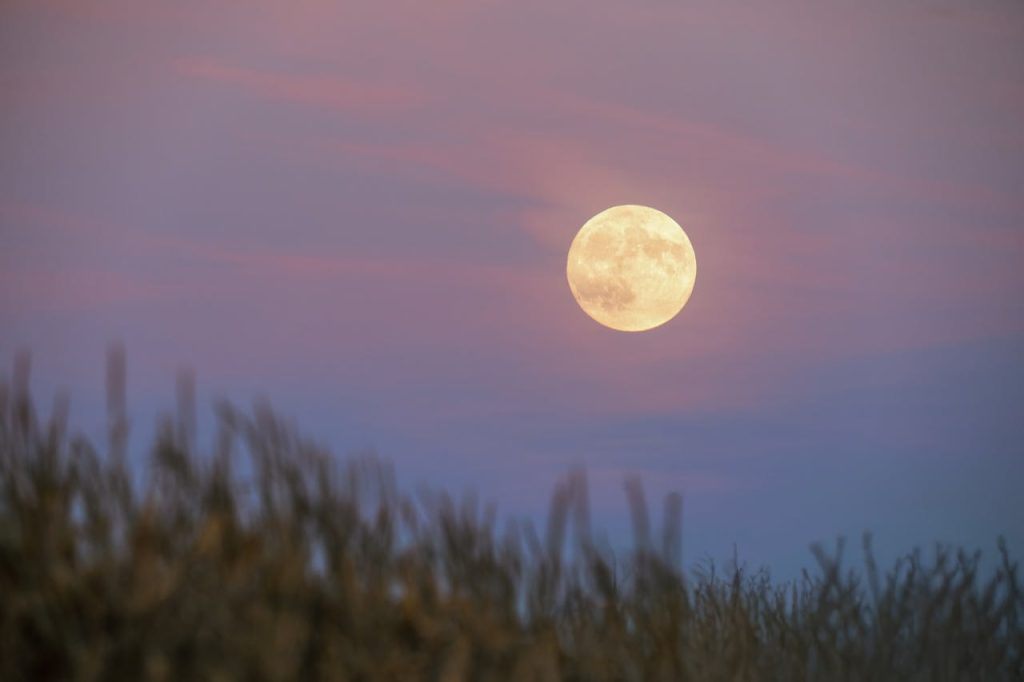
The fastest test is simple: hold an outstretched finger or fingernail next to the Moon. NASA says the Moon will measure about the same against it whether the Moon is low or high.
That quick comparison works because it checks apparent size directly instead of relying on intuition. The illusion loses power when there is a clear reference right in front of the eye.
Another good method is to look at the Moon through a paper tube. That removes much of the surrounding scene and strips away some of the horizon context that helps trigger the illusion.
NASA also mentions the upside-down trick of bending over and looking back between the legs. It sounds odd, but it can weaken the effect by disrupting the brain’s usual framing of the landscape.
The strongest proof is a pair of photos taken with the same camera zoom setting. One should be taken near moonrise and another later when the Moon is high.
Put those images side by side, and the Moon’s width will match even if memory insists the horizon Moon looked much larger. That gap between memory and measurement is the illusion in plain view.
The Color Change Is Real
The size illusion is not the whole story.
NASA points out that the Moon really does look more yellow or orange near the horizon. That part is caused by light traveling a longer path through the atmosphere.
On that longer path, more short blue wavelengths scatter away before the light reaches the eye. What remains is richer in red and yellow tones, which is why moonrise often looks warm and cinematic.
Dust and pollution can deepen that warm color even more. So the brain is inventing the size jump, but the atmosphere is genuinely changing the color.
Supermoon Size Versus Horizon Illusion
A supermoon is a real orbital event, not a perception trick. NASA defines it as a full Moon near perigee, the closer part of the Moon’s elliptical orbit around Earth.
NASA says a full Moon at its closest can appear up to 14 percent bigger and 30 percent brighter than the faintest full Moon near apogee, though the size difference can still be hard to notice casually. That is a real physical size change in the sky, just much smaller than most people expect.
The confusion happens when a supermoon rises low on the horizon and the illusion stacks on top of the real size increase. Then a modest physical difference gets amplified by the brain into something that feels enormous.
Why The Illusion Still Matters
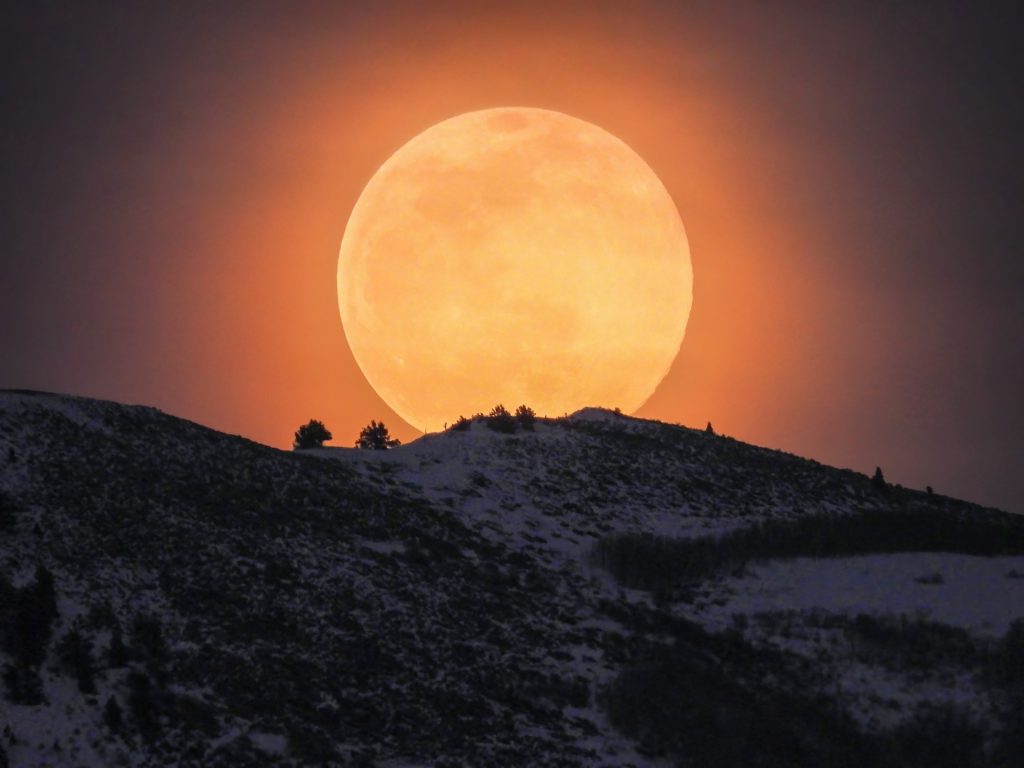
The Moon illusion is a useful reminder that seeing is not the same as measuring.
NASA’s explanations make the point clearly: the sky can look obvious and still be wrong in ways the brain cannot easily detect. That is exactly why simple tests with fingers, tubes, and photos are so satisfying.
It also shows how science often works in real life. Researchers can agree on what is happening, reject bad explanations, and still debate the exact mechanism behind the effect.
And that is part of the appeal of moonrise itself. A familiar object still manages to surprise the eye, challenge the brain, and make an ordinary evening feel a little stranger.